No Judgment, Just Vibes: Why Your Discord Server Might Be Your Most Honest Relationship
Here's a scenario that probably sounds familiar. You're sitting in your therapist's office — or maybe a Zoom window with a therapist's face in it — trying to explain why you feel more understood by a group of people you've never physically met than by the friends you grew up with. Your therapist nods, takes a note, and you immediately feel a little weird about it.
You shouldn't. Because what you're describing isn't avoidance or social dysfunction. According to a growing number of mental health professionals, it might actually be one of the healthiest things happening in your social life.
The Setup Nobody Talks About
Most friendships form around circumstance. You went to the same school, live in the same apartment building, or got hired at the same company around the same time. That's not a bad thing, but it does mean a lot of your closest relationships are built on geographic and logistical luck rather than genuine compatibility.
Gaming communities work differently. When you find your people on Discord — whether it's a server for a specific MMO, a shared love of survival crafting games, or a competitive fighting game scene — you're already starting from a foundation of shared interest. That might sound obvious, but psychologically it's significant. Researchers who study social bonding have long noted that shared goals and collaborative problem-solving accelerate trust-building in ways that passive proximity simply doesn't.
Dr. Rachel Kowert, a research psychologist who has spent years studying the intersection of gaming and mental health, has pointed out that games create what she calls "scaffolded social interaction" — basically, the game gives you something to do together, which removes the awkward pressure of pure socializing. You're not just hanging out hoping conversation happens. You're raiding a dungeon. You're coordinating a defense. You're trash-talking each other's build choices. The interaction has structure, and that structure is surprisingly good at producing real connection.
Voice Chat and the Accidental Vulnerability Loop
Here's where it gets genuinely interesting. Voice chat — something millions of gamers use without a second thought — turns out to be a weirdly powerful intimacy engine.
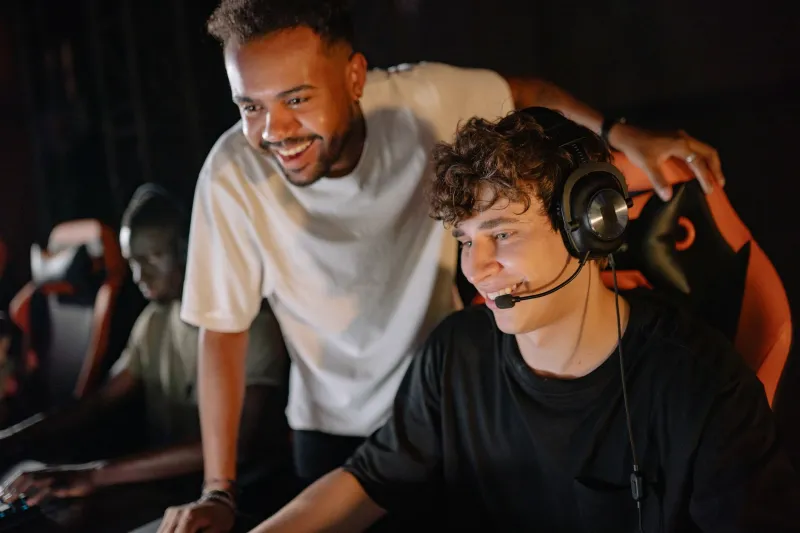
When you're playing a stressful game with your crew, you're not performing. You're reacting. You curse when you die. You laugh when something goes sideways. You get quiet when you're focused and loud when you win. All of that is raw, unfiltered emotional expression happening in real time with other people who are doing the exact same thing.
Compare that to a lot of in-person adult socializing, which tends to be highly curated. You're at a dinner party, a work happy hour, or a family function — environments where there's enormous social pressure to present a polished version of yourself. You edit. You perform. You manage impressions.
In a voice chat session at 1 a.m. where you've been grinding for three hours and someone on your team just pulled off an insane clutch play, nobody is managing impressions. And that mutual vulnerability — even when it's small, even when it's just shared frustration over a game mechanic — creates what psychologists call "reciprocal self-disclosure," one of the primary building blocks of genuine intimacy.
The No-Stakes Paradox
One of the most counterintuitive things about gaming friendships is that they often feel lower stakes than real-life relationships — and that's actually what makes them work.
In traditional friendships, there's a lot riding on every interaction. You might work with this person. You might see them at every social event for the next decade. You share mutual friends who will absolutely hear about any falling out. That weight makes people cautious, and caution is the enemy of authenticity.
Online gaming communities, at least initially, carry less of that social baggage. You can be honest about your opinions. You can be weird. You can admit you're having a rough week without worrying about it becoming office gossip or family drama. The relative anonymity of online spaces — even when you've been in a server for years and everyone knows your username, your playstyle, and your opinions on every game released since 2018 — creates a kind of psychological safety that's genuinely rare.
Multiple therapists interviewed for this piece noted that clients who describe their gaming communities as primary support systems often use the word "safe" unprompted. That's not a coincidence.
When the Algorithm Gets It Right
There's also something to be said for the filtering effect of shared gaming taste. Finding a community built around a specific game, genre, or playstyle means you've already self-selected for a certain kind of person. Not just someone who plays games, but someone who plays these games, in this way, and probably thinks about them the way you do.
That's a level of specificity that most traditional social structures can't offer. Your coworkers might span every conceivable personality type and value system. Your Discord server for a niche strategy game? Probably pretty well-curated by the nature of the thing itself.
This is something the PixelHive community knows intuitively. The people who show up consistently in the same spaces — whether that's a specific game's subreddit, a long-running Discord, or a dedicated community forum — aren't there by accident. They chose to be there, repeatedly, over time. That intentionality matters.
What Therapists Actually Think
It's worth being direct about this: most therapists aren't threatened by their clients' gaming friendships. The ones who study this stuff tend to be genuinely enthusiastic about what online communities can offer.
The consistent caveat is that online connection works best as a complement to, rather than a complete replacement for, other social structures — not because it's somehow less real, but because having multiple types of connection tends to support better overall mental health. A gaming crew that becomes a genuine support system is a great thing. A gaming crew that becomes the only thing, particularly if it's filling a gap created by social anxiety or avoidance, is worth examining.
But the stigma that still lingers around online friendship — the idea that it's a consolation prize for people who can't make "real" friends — is increasingly out of step with both the research and the lived experience of millions of Americans who built their most meaningful relationships through a headset and a shared love of a game.
The Real Flex
At the end of the day, what gaming communities have quietly figured out is something that social scientists have been trying to engineer for decades: the conditions under which people actually let their guard down and connect with each other for real.
Shared purpose. Low-stakes interaction. Repeated exposure. Mutual vulnerability. A reason to show up consistently over time.
Your Discord crew didn't stumble into that by accident. The structure of gaming communities — the way they're built around doing things together, communicating in real time, and returning to the same space repeatedly — creates those conditions almost automatically.
So the next time you're in your therapist's office trying to explain why your online squad gets you in a way that's hard to articulate, maybe just say this: we built something real. It just happened to start with a game.